Google's 'Love, Rendered' Shifts AI Focus from Utility to Emotion
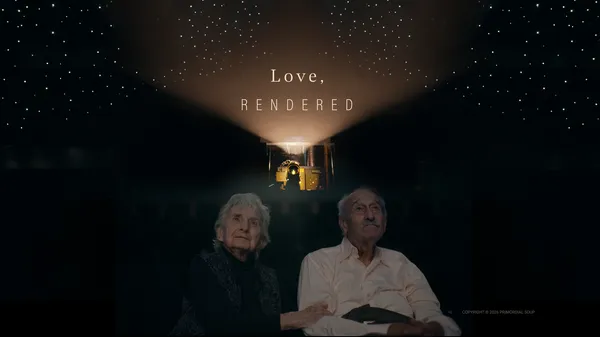
Google's 'Love, Rendered' short film, a collaboration with DeepMind, is a calculated strategic maneuver, not just a technical showcase. It frames generative AI as a tool for emotional resonance and personal memory, directly countering the industry's focus on enterprise productivity and impersonal automation. This move aims to reshape the public narrative around AI, shifting from dystopian fears to aspirational, human-centric applications. As rivals like Adobe and OpenAI double down on professional-grade tools, Google is cultivating a brand centered on sentiment and hyper-personalization, setting the stage for a new category of consumer AI products. This project fundamentally alters the value proposition of generative content tools. Instead of competing on raw output quality or processing speed, Google is creating an asymmetric advantage by focusing on emotional fidelity—its ability to translate abstract memories into evocative imagery. This pressures competitors like Midjourney and Stability AI, whose models are primarily judged on technical and aesthetic benchmarks, not narrative authenticity. The winners are creators seeking to personalize storytelling at scale, while the losers are stock photography and generic asset libraries, whose business models are directly threatened by hyper-specific, emotionally-tuned AI generation. Looking ahead, this signals Google’s trajectory towards integrating generative AI deeply into consumer products like Google Photos and YouTube Create. Within 12-18 months, expect features that allow users to 'render' their own memories from text prompts or old photo albums. The real test will be whether Google can productize this capability while navigating the immense ethical pitfalls of creating and altering personal histories. This initiative is not merely a film; it's a beta test for an entirely new class of consumer AI centered on manufactured nostalgia and emotional services.