Nvidia CEO Positions AI as National Security Imperative
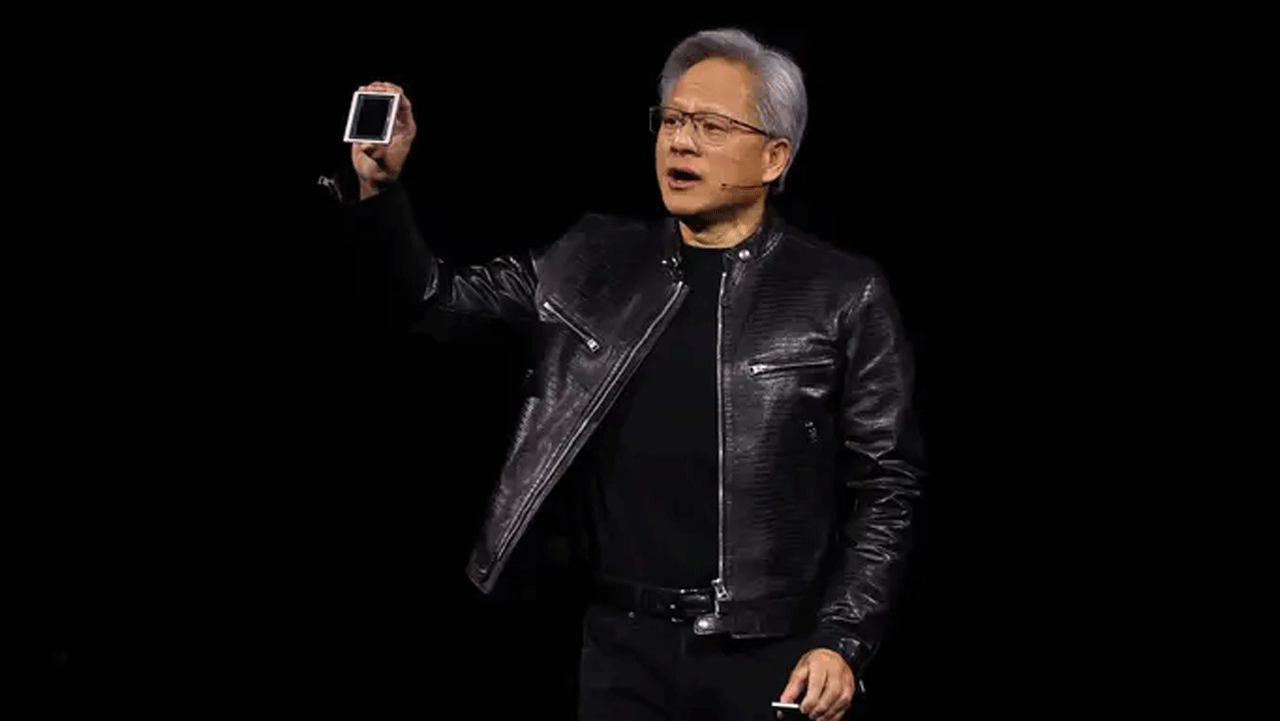
Nvidia CEO Jensen Huang’s assertion that AI will trigger an Industrial Revolution-scale shift isn’t mere hyperbole; it’s a strategic declaration amid an intensifying US-China AI arms race. By framing AI dominance as a national-security imperative, Huang is directly influencing policy debates surrounding technology export controls and federal R&D funding. This statement gains urgency following recent moves by Washington to restrict advanced semiconductor technology, positioning AI not just as an economic engine but as the central battleground for geopolitical influence for the next decade. Huang’s rhetoric aims to galvanize a unified national strategy, with Nvidia’s hardware at its core. The mechanics of this transformation create a clear bifurcation in the labor market. The winners are not just "new job" holders, but professionals in creative, strategic, and interpersonal fields whose capabilities are augmented by AI, turning analytical insights into a commodity. Conversely, workers performing repetitive knowledge tasks—from paralegal research to financial modeling—face immediate devaluation. This fundamentally alters the competitive landscape for enterprise software, forcing players like Salesforce and SAP to integrate generative AI deeply into their platforms, or risk becoming obsolete interfaces on top of more intelligent systems powered by Nvidia’s GPUs. Looking forward, Huang’s call to action signals a push for massive public-private investment in sovereign AI capabilities within the next 12-24 months. The critical variable is no longer chip production, but the speed of workforce retraining and educational reform. Failure to adapt university and vocational curricula to focus on AI-augmented problem solving, rather than rote skills, will create a severe talent bottleneck by 2027, undermining US competitiveness regardless of hardware superiority. The real test will be whether the US government can orchestrate an economic and educational transition as effectively as it has managed semiconductor policy.