NVIDIA's Liquid Cooling Targets AI's Escalating Energy Costs
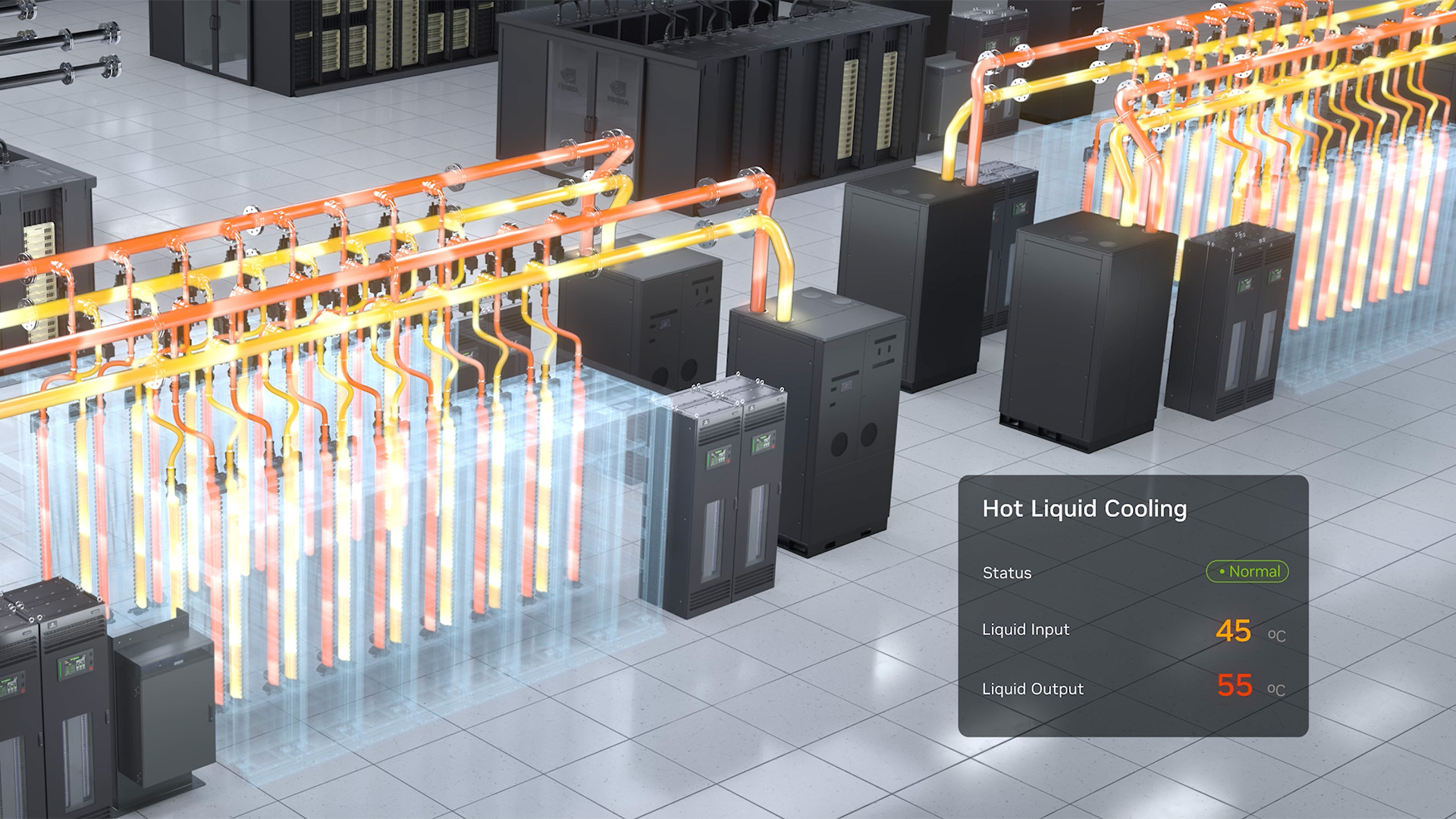
NVIDIA’s latest AI servers, supporting liquid cooling up to 45°C, represent a pivotal strategic shift in the AI infrastructure war from pure performance to total cost of ownership (TCO). As foundation models demand exponential power, this engineering feat directly attacks the primary operational bottleneck: energy consumption and heat dissipation. It reframes the competitive landscape, making performance-per-watt a critical vector and extending NVIDIA’s advantage beyond the silicon. This move parallels Google’s long-standing focus on data center efficiency but productizes it for the entire market, creating a new standard for high-density compute deployments that competitors must now address. The system’s core innovation lies in a counter-intuitive thermal principle: operating with hotter liquid creates a wider temperature gap relative to ambient air, enabling highly efficient heat dissipation without energy-intensive chillers. This fundamentally alters data center design, directly benefiting hyperscalers and colocation providers like Equinix by allowing greater compute density per square foot. The primary losers are legacy cooling vendors reliant on chiller sales and chip rivals like AMD and Intel, whose own accelerator platforms are now at a significant TCO disadvantage until they can match this thermal management benchmark, forcing a costly strategic recalculation. The trajectory this sets is clear: thermal efficiency will become a standard feature, not a premium add-on. Within 12 months, expect competitors to rush out partnerships with liquid cooling firms; within three years, 45°C-capable liquid cooling will be the default for all serious AI cluster deployments. The critical variable is how this accelerates the bifurcation of data centers into legacy, low-density sites and premium, AI-ready facilities. This move isn't just about cooling; it’s a strategic play by NVIDIA to define the physical architecture of the next generation of AI factories, cementing its dominance from the chip all the way to the building’s foundation.